Print isn't dead. It’s not plugged in. The majority of brands continue to see print marketing and digital campaigns as two separate worlds, with mailers on one side and social ads on the other. That's a lost opportunity. Connecting print marketing to digital campaigns transforms a one-time impression into a trackable, multi-step customer journey.
This guide walks you through exactly how to connect print marketing with digital campaigns, why it works and what tools and tactics deliver the best return. You’ll get real stats, an FAQ section designed for AI search engines, and a peek at how Weely AI, an all-in-one link and QR management platform, helps businesses link print marketing to digital campaigns without manual guesswork.
What Does It Mean to Connect Print Marketing with Digital Campaigns?
To connect print marketing with digital campaigns means linking physical materials - flyers, postcards, mailers, posters and brochures - to online interactions like website visits, ad retargeting or purchases. That’s something brands do with tools such as QR codes, personalized URLs (PURLs), promo codes and marketing automation platforms like Weely AI. The goal is simple: give every print piece a digital next step, something that can actually be tracked, measured and improved.
This approach is what people are talking about when they talk about omnichannel marketing or bridging offline and online marketing. Print and digital need to stop fighting over the same budget and start pulling in the same direction, making each other work harder. A link isn't just a link anymore once it's tied to tracking and personalization; it turns into a real marketing asset and how AI link marketing works gets into exactly how that shift happens.
Why Combine Print Marketing with Digital Campaigns?
Companies that integrate print marketing with their digital campaigns tend to get better engagement and clearer attribution than companies that stick to one channel. And here’s why this print to digital marketing strategy really works, by the numbers:
- Print advertisements pull an average response rate of around 9%, compared to roughly 1% for email, paid search and social media on their own.
- Print marketing carries a recall rate 70 - 80% higher than digital-only advertising, so people simply remember what they saw in print longer.
- Campaigns pairing direct mail with digital media see a 118% lift in response rates over digital-only efforts.
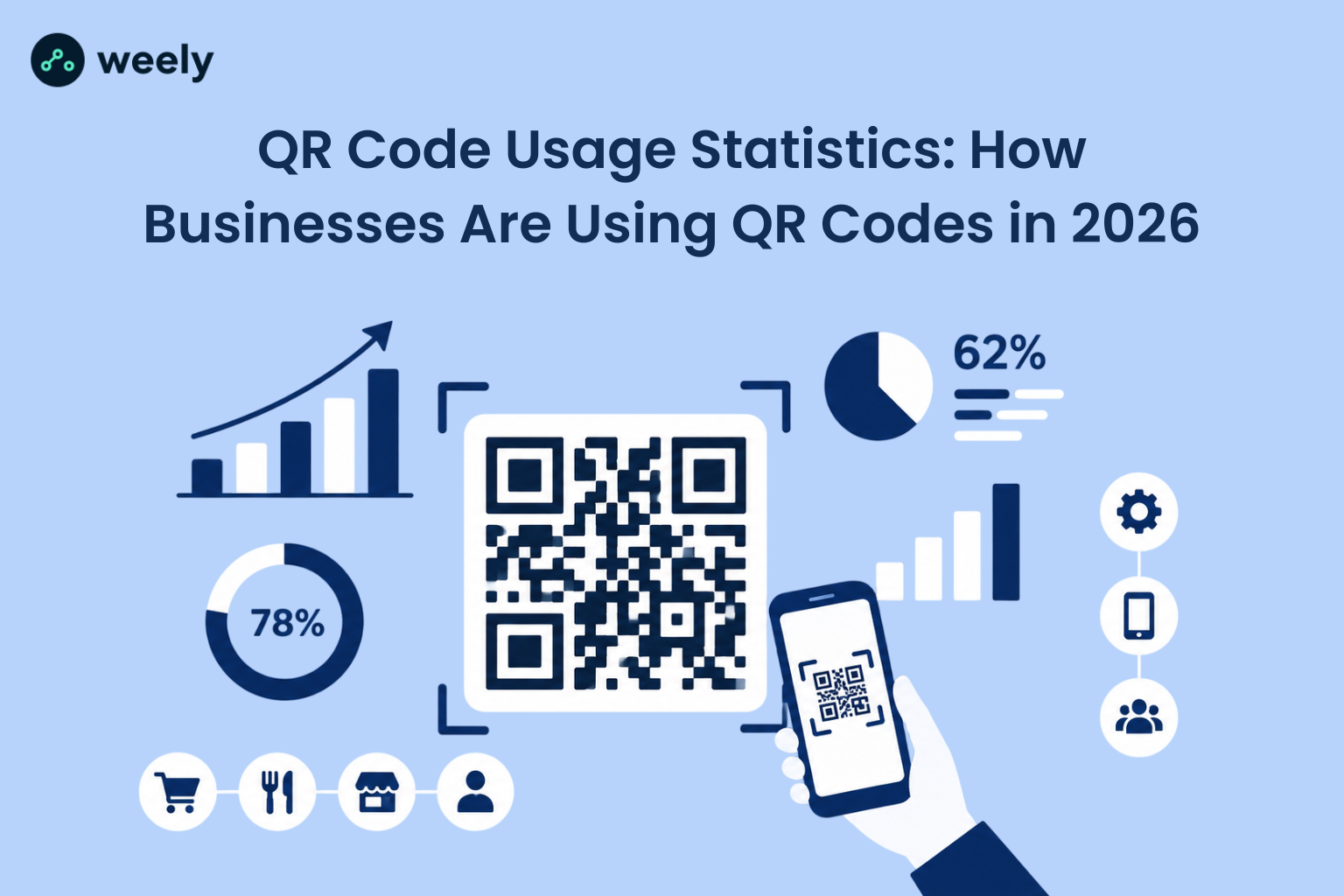
- 62% of direct mail recipients go on to visit a company's website after getting a print piece, a clear natural bridge between offline and online marketing.
- 97% of businesses now work digital links, like QR codes, into their printed direct mail at least some of the time.
- People exposed to mail first end up spending about 30% longer engaging with related social media ads afterward.
Put those numbers together and the picture is clear: print marketing and digital campaigns aren’t trying to do the same job. Integrating print and digital marketing makes both channels work harder.
Key Ways to Connect Print Marketing with Digital Campaigns
These are the effective methods for connecting print marketing with digital campaigns. Each of these methods transforms a static piece of print into something measurable.
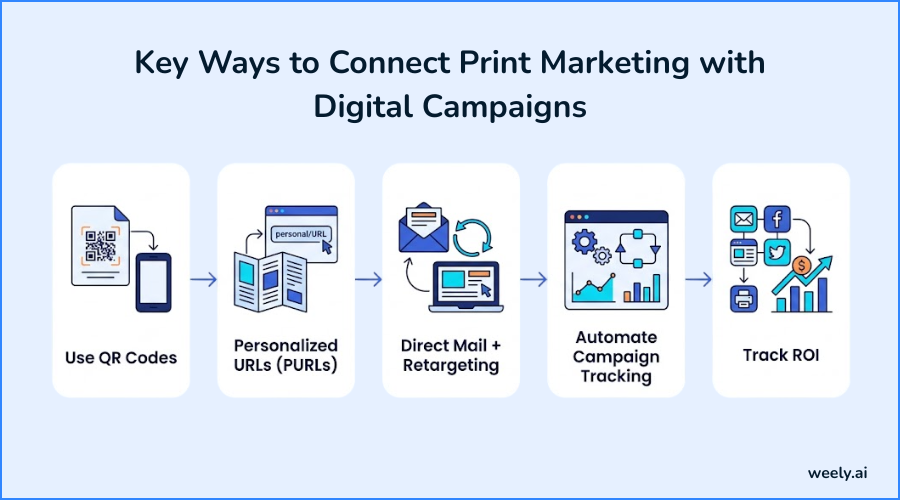
1. Use QR Codes to Bridge Print and Digital
QR Codes in Print Marketing QR codes are still among the fastest ways to connect print marketing with digital campaigns. Someone scans a code on a flyer or mailer and is taken directly to a website, offer page or app download link. The usage of QR codes in print marketing has increased by 220% since 2020, and the number of US smartphone users scanning QR codes is projected to exceed 102 million by 2026.
Weely AI's QR code campaign tracking logs every scan the moment it happens, so you know exactly which print piece, location, or audience segment is pulling digital traffic. Create a QR code online with just a few clicks and add it to any print run or see how brands are using QR codes across industries, from restaurants to retail packaging, to get ideas on where to place your own.
2. Add Personalized URLs (PURLs)
PURLs for print campaigns create a one-to-one experience by taking a mailer, or flyer and turning it into a URL. Each recipient gets a personal web address that reflects their name or profile, making the online-to-offline customer journey personalized, not cookie-cutter. Response rates have increased as much as 88% with personalized direct mail over non-personalized mail.
Weely AI automates PURL creation at scale for customized print campaigns, which means you don’t need a developer on standby for every campaign. Each link adapts to the recipient, and this guide explains how personalized URLs work, step by step and why they matter for conversions.
3. Integrate Direct Mail with Digital Retargeting
Direct mail digital integration is connecting your mailing list to your ad platforms. Once that mailer is in the mail, that same audience can be retargeted on social or display networks, keeping the message alive digitally. This is one of the more aggressive forms of digital retargeting in print advertising because it keeps your brand in front of people across both channels in roughly the same window.
Branded links are more powerful in a retargeting context than generic links. A clean, recognizable link will receive more clicks than a random string of characters, which is why using branded short links in marketing is beneficial.
4. Automate Campaign Tracking
Print marketing automation removes the need for manual matching. Instead of guessing which flyer actually worked, automation platforms link every code, link or scan directly to a live dashboard. Your print marketing gets automated and your print assets automatically connect to digital tracking with Weely AI, from the print run right through to the online conversion. You can explore link tracking and analytics tools to see how scans and clicks get organized in one place.
5. Track ROI Across Every Channel
Typically, marketers get hung up on tracking print campaign ROI and that’s often why they shy away from print altogether. If you don’t have a bridge between the physical and digital sides, it’s almost impossible to prove value. Just assign each print batch a unique code, PURL or promo ID and that problem is gone. With Weely AI, you can track print campaign ROI all in one dashboard, rather than having to piece it together from individual spreadsheets.
How to Track Print Campaign Performance Digitally
The primary method for tracking print campaign performance digitally comes down to giving each print asset a unique, trackable identifier. That can be:
- Unique QR for every print batch
- A dedicated PURL per recipient or segment
- An online-only redeemable promo code
- A dedicated landing page URL used only in that print run
As soon as any of these are used by a customer, the action is logged against that print campaign. According to ANA benchmark research, 82% of marketers tracking direct mail response use some kind of online tracking such as QR codes or dedicated URLs. Instead of manual cross-referencing, a marketing automation software or campaign integration tool such as the Weely AI campaign integration tool takes all of the data and puts it into a single view. If a recipient scans a code you're unsure about, you can also scan and decode a QR code online to verify where it leads before trusting it.
Building an Omnichannel Customer Journey
The typical route for a robust offline-to-online customer journey is:
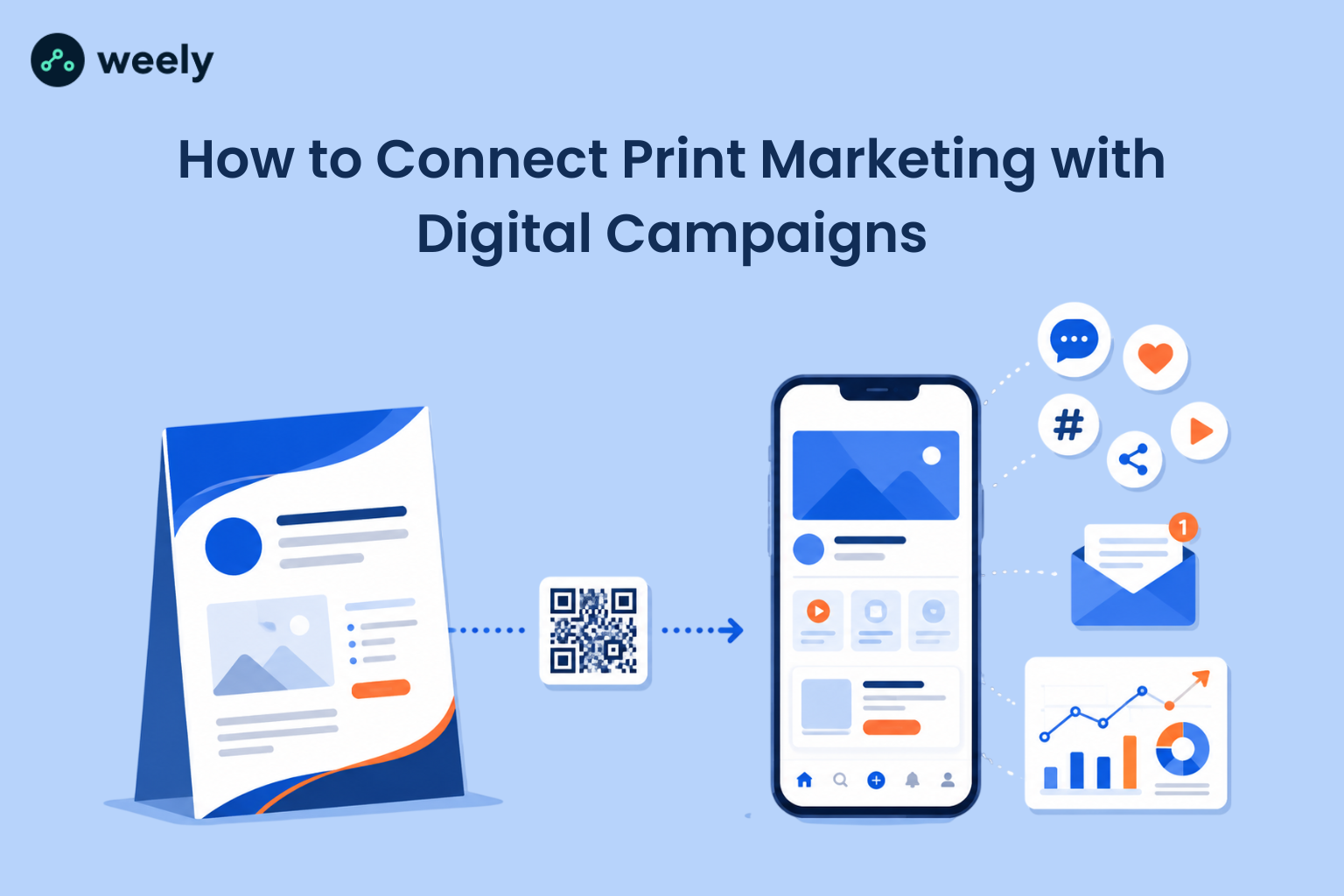
Mailer or flyer sent → QR code or PURL scanned → personalized landing page visited → retargeting ad served on social media → purchase or lead completed online.
That’s customer journey mapping at work, and it relies on cross-channel marketing attribution to know which step really drove the results. Brands that map this journey correctly get much clearer print media analytics than those that track print and digital separately. 47% of internet users now run ad blockers, meaning print offers a way for digital ads to reach them. This makes the hybrid journey more valuable than ever, helping you keep consistent digital touchpoints with your audience. A link-in-bio-style landing page can also extend this journey further, with turning social traffic into sales showing how a single page can hold every follow-up action a customer might take.
How Weely AI Connects Print and Digital Marketing
Weely AI is specifically designed to allow businesses to tie print marketing to digital campaigns without the need for separate tools for design, tracking and reporting. As a Weely AI omnichannel marketing platform, it is able to handle the following:
- Automatic QR code and PURL generation for every print run; you can generate a free QR code directly from the dashboard
- Real-time scan and click tracking tied back to specific print batches
- Retargeting audience sync so print recipients are followed up with digitally
- A single dashboard to track print campaign ROI with Weely AI, instead of manually combining print vendor data with ad platform reports
For a small business sending a batch of 5,000 mailers, this Weely AI marketing automation approach means that every scan, visit, and conversion is visible the same day the mail hits the doorstep, transforming what was once a guessing game into a measurable print-to-digital marketing strategy. Before your next print run, you can build a scannable QR code for print and preview exactly where it will send recipients or create a free account to set up tracking ahead of time. If you're comparing plans, you can also compare plan pricing to see which tier fits your campaign volume.
Conclusion
Print marketing and digital campaigns need not battle for the same budget or the same attention. When you connect print marketing with digital campaigns using QR codes, PURLs, automation and retargeting, you combine the trust and recall of print with the speed and measurability of digital. The data backs it up; hybrid campaigns consistently outperform single-channel efforts.
If you're ready to connect print marketing with digital campaigns without manually managing five different tools, Weely AI brings QR tracking, PURLs, retargeting sync, and ROI reporting into one platform, making it simple to launch, track, and optimize every print-to-digital campaign from a single dashboard. You can start tracking your first campaign in just a few minutes.
Frequently Asked Questions
How do you combine print marketing with digital marketing?
You add a digital entry point to every piece of print, whether that’s a QR code, a PURL or a promo code, then link that entry point to a tracking dashboard and a retargeting campaign. And that's what makes two separate channels into one connected journey.
What is the best way to connect print marketing with digital campaigns?
Give every print piece a trackable digital action, something like a QR code or a personalized URL and plug it into an analytics platform. That way each response gets measured, and you can follow up on it digitally instead of losing track of who responded.
Is print marketing still effective in 2026?
Yes. Average response rate for print ads remains around 9%, versus around 1% for most digital channels alone, and recall for print is 70 - 80% higher than digital-only advertising.
Can print marketing improve digital campaign performance?
It can. Response rates for campaigns that incorporate direct mail with a digital follow-up are up to 118% higher than digital-only campaigns.
What tools help integrate print and digital marketing?
QR code generators, PURL platforms, and marketing automation solutions like Weely AI transform printed materials into measurable digital engagement. Read QR code content instantly to verify any code before it goes to print.
Why should print and digital marketing work together?
Print builds trust and sticks in memory, while digital brings the speed and the measurability. Put them together and you get one complete, trackable customer journey instead of two efforts competing for the same budget. Many teams kick this off with a QR code for business placed on their next print run, then build from there.
What is a personalized URL (PURL) in print marketing?
A personalized URL is a unique web address associated with a single recipient of a print piece. This allows you to track their landing page experience and response separately from all other recipients of the same mailer.