Marketing today is not about sending the same message to everyone in the digital world. Customers want experiences that are personal, relevant and timely. That’s why personalized URLs have become one of the most effective tools of modern digital marketing.
In this Weely AI guide you will learn what personalized URLs are, how personalized URLs work, why personalized URLs matter, and how businesses use personalized URLs to increase engagement and conversions in 2026.
What Are Personalized URLs?
Personalized URLs are unique web links. Businesses create them for every user. They also produce them for audience groups.
Normal URLs never change for anyone. But personalized URLs are different. They are different for every user. They use user data. Name, email address, behaviour, or advertising source are some of the details.
For example:
- Standard URL: www.weely.ai/offer
- Personalized URL: www.weely.ai/john-smith-offer
This little tweak makes the experience more personal. It also increases the users’ engagement.
Personalized URLs in marketing Businesses use these links to increase engagement. They also track user behavior. They also offer custom landing pages. This concept is closely related to branded links vs generic links, where businesses choose between customized, brand-visible URLs and standard short links to improve trust and performance tracking.
These links are called PURLs (Personalized URLs). They are used for email marketing by businesses. They send them out in direct mail too. AI marketing systems also use them.
How Do Personalized URLs Work?
It is important to understand how personalized URLs work in marketing campaigns. It sounds like a technical process. But it takes simple steps. Businesses first collect data. Then they create special links such as utm link. Then they deliver a tailored experience. They do track results, finally.
Every step gets marketing closer to relevance. It also makes it easier to measure results.
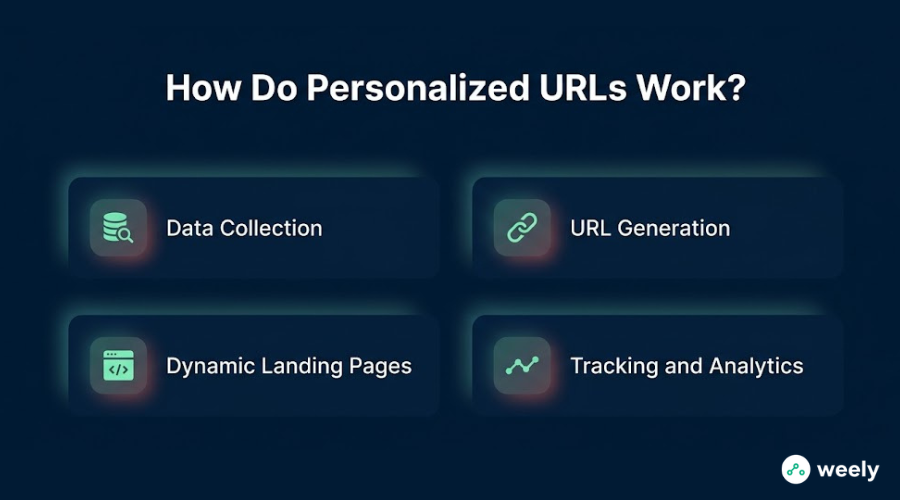
1. Data Collection
Businesses are collecting many sources of user data. CRM systems, email sign-ups, website visits, buying behavior and advertisements are some of them. Businesses use this data for personalization purposes.
Also, good data leads to better results. The more detailed the data, the more useful personalized URLs will be. Today’s systems combine behavioral data with first-party data. This helps to build full customer profiles. It also enhances targeting.
2. URL Generation
Following the data collection, the systems produce unique custom URLs for each promotion. Each user gets a unique link. The link reflects their identity, preferences or customer journey point.
For example, a returning customer will get a different URL than a new lead. This gives marketers tight control over messaging. They also avoid the manual creation of thousands of links.
3. Dynamic Landing Pages
When users click on a personalized URL, they land on a personalized landing page. This page isn’t static. Depends on the visitor.
Content is updated in real time. It can show the user's name, related offers, suggestions according to location, previously viewed products, etc. This aspect has to do with dynamic URL personalization. Each visitor sees a page tailored to him.
4. Tracking and Analytics
Every click on a personalized trackable link is logged. Marketers see who clicked. They can also see what they did and when they clicked. They also track conversions.
Marketers get valuable information as a result. They are aware of the greatest messaging. Additionally, they observe which audience groups react most strongly. This enhances and increases the efficacy of future efforts, helping businesses optimize marketing performance over time.
Types of Personalized URLs
There are a few formats of personal URLs. Each format is for different marketing needs. It also supports different automation levels.
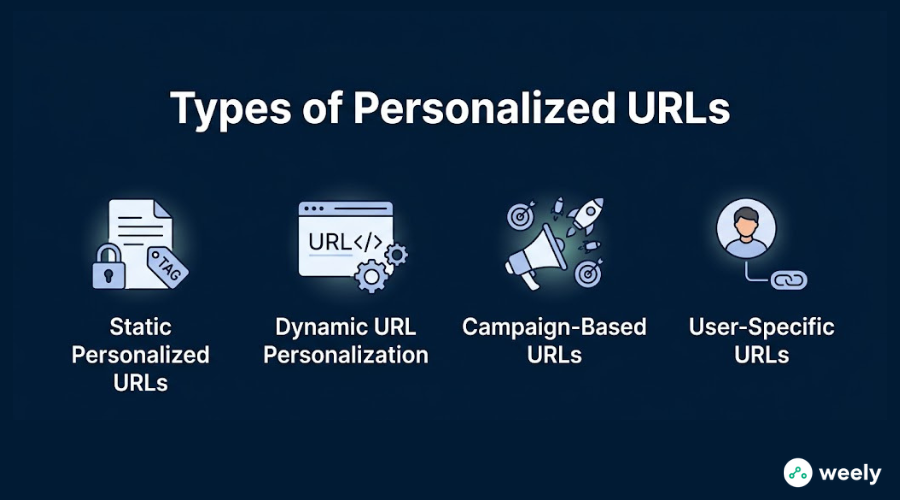
1. Static Personalized URLs
Static personalized URLs are pre-generated. Companies assign them to users in advance. They’re stationary. However, there is still some personalisation available. For example, they could contain a user’s name or ID.
These URLs are commonly used in email campaigns and printed materials. They are good when teams need customization. But they don’t need real-time updates.
2. Dynamic URL Personalization
It is more complicated to use this method. Systems create or modify URLs in real time. Their method is based on how people act. So, marketers can quickly change material based on what users do.
For example, the user may go to a pricing page. They may then be sent a dynamic URL personalization token. This link may reveal discounts or other plans.
3. Campaign-Based URLs
Campaign URLs are used for targeted marketing campaigns. These include seasonal promotions, product launches, and webinars. And each campaign can have multiple custom URLs, too. These URLs target different audience segments.
This makes it easier for marketers to measure the results of their campaigns. They can also more readily compare strategies.
4. User-Specific URLs
User-specific URLs are highly customized links. They are created by businesses using CRM or customer data. They also use behavioral information. These URLs can include things like past purchases, level of engagement, or lifecycle stage.
This type of personalized URL in marketing is also common in SaaS, e-commerce and enterprise systems, especially when using editable destination URLs to allow flexible updates to the final landing page without changing the shared link.
Why Personalized URLs Matter in Marketing
Personalized URLs will become more and more important in marketing in 2026. Consumers now expect digital experiences to be relevant. And so marketers need to personalize.
1. Higher Engagement
People interact more with content that feels relevant. A personalized link makes you want to click. It also builds confidence. This results in an increase in click-through rates.
When users see content that relates to their name, interest or behavior, they connect to the brand more. They also think it’s more of a personal thing.
2. Better Conversions
Personalization drives conversions. Users act more when pages match their intent. They can sign up. They could also purchase a product or request a demo.
That’s why personalized URLs (PURLs) in marketing are common in high-performance campaigns.
3. Improved Customer Experience
A frictionless experience means less friction. Users create content to view it. They don't see generic pages. Such content leads to more satisfaction.
Over time, this approach deepens relationships. It also increases the lifetime value of customers.
4. Stronger Marketing Attribution
Marketers know what campaigns are, and they work. They keep track of which messages get the most replies. This helps them to improve their ROI.
Trackable, personalized links make attribution a breeze. And it becomes actionable. Marketers can see which audience segments convert better.
5. Better Data Insights
Each interaction produces useful behavioral data. Marketers learn patterns. They also watch what users do. They also allow for better segmentation of the audience.
This helps them to improve their future campaigns. Besides that, it helps them choose better, often by using link management tools to organize, track, and optimize all campaign URLs in one place.
Benefits of Personalized URLs in Marketing Campaigns
Benefits of trackable personalized links to businesses in the long term.
These are better campaign performance, better customer targeting and better automation. Over time, businesses can build marketing systems that are smarter and automatically adjust to how users engage, especially when using best link management tools to streamline, track, and optimize all their marketing URLs efficiently.
One of the biggest benefits is the ability to scale. Personalized URLs in email marketing allow brands to send one-to-one communication to thousands of users without having to do it manually.
Common Use Cases of Personalized URLs
Commonly used to increase engagement and track campaigns, personalized URLs. They help businesses to connect better with users.
Email Marketing Campaigns
Email marketers use personalized URLs to deliver messages that are relevant to each user’s interests. This makes them more engaging.
No generic links, a unique experience for every user. And that makes emails more personal. They also seem less robotic. So users will be more likely to click and interact.
Direct Mail Marketing
Offline campaigns often use printed QR codes that direct to personalized landing pages. It ties physical marketing into digital channels. Therefore, businesses can track offline responses accurately.
It also boosts response rates. Users get a smooth digital follow-up. That’s why the campaign becomes more effective, especially when integrated with offline marketing strategies.
E-commerce Personalization
E-commerce websites personalize their dynamic URLs with product suggestions, discounts and reminders about abandoned carts. This helps recover lost sales. It also increases repeat purchases.
Customized shopping journeys increase conversion rates. These are also important in competitive markets. Businesses also benefit from greater customer loyalty.
Lead Generation Campaigns
Custom URLs are used by businesses to capture quality leads. Each landing page is designed for a particular audience. Which means more conversions.
This approach is a common practice in SaaS and B2B marketing. It helps businesses better target users. So the quality of lead goes up a lot.
Event Marketing
Event organizers use Trackable to send personalized event links to register, remind and follow up. That boosts attendance. It also guarantees smoother communication before and after events.
Meanwhile, the participants are part of the whole event. This improves the event’s overall performance.
Personalized URLs vs Vanity URLs
Personalized URLs and vanity URLs are different. One focuses on users, the other on branding.
Benefits of Personalized URLs in Email Marketing
Personalized URLs in email marketing lead to better performance across the board.
Emails are more relevant, landing pages are more personalized, and users are more likely to act. This blend improves short-term conversion and long-term customer relationships.
How AI Is Transforming Personalized URLs
AI is changing personalized URLs from fixed links into smart tools. The rise of AI link marketing is making personalized URLs smarter, more dynamic, and more effective than ever before.
Weely AI and other AI-powered personalization marketing tools do the linking for you. In real-time, they can also monitor individual behaviour. Then they refresh content for each user. So conversions increase.
This further creates hyper-personalized URLs. Each interaction helps machine learning models learn. They also predict what users will do and what they will need. And they make every experience more useful and interesting.
How Weely AI Uses Personalized URLs
Weely AI helps businesses scale personalization. It uses automation and intelligence. It also improves both speed and results. So, marketing becomes easier.
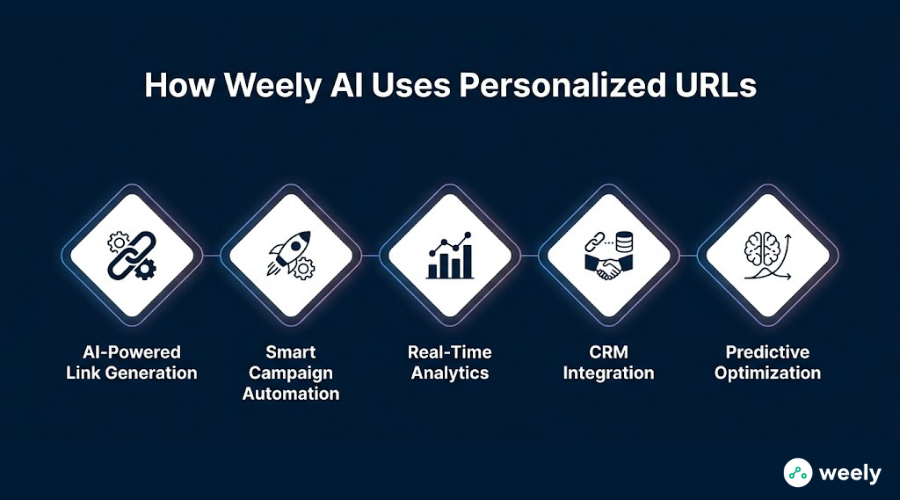
1. AI-Powered Link Generation
Weely AI generates personalized URLs for every user. It does that automatically. So there is no manual work. And it reduces mistakes. Each customer receives a unique link. So every experience feels like a personal one.
2. Smart Campaign Automation
Custom URLs for campaigns Businesses launch large campaigns in seconds. This is easy marketing. It also simplifies. So teams are easily scalable. They are also less stressed out.
3. Real-Time Analytics
Weely AI monitors every trackable personalized link. So marketers get to see live data. They see conversions, engagement and performance. The dashboard also provides clear insights.
4. CRM Integration
Weely AI integrates with CRM systems. So it uses new customer data. It enhances personalization. It also makes targeting better. The results are also more accurate.
5. Predictive Optimization
Weely AI predicts user behavior with AI. So it optimizes campaigns automatically. The longer you play, the better. Also, less work needs to be done by hand. And it saves time.
The Future of Personalized URLs (2026 and Beyond)
Personalized URLs are now fully AI-powered for the future. This makes marketing more predictive, automated and ultra-personalized. Businesses will migrate from static links to dynamic URLs. These URLs will give each user a unique, real-time experience. Moreover, these systems will learn continuously from the behavior of users. This helps increase engagement and conversions over time.
Major developments have been:
- AI-powered personalized URLs that adapt instantly
- Content changes in real time according to user actions
- Predictive customer journeys to guide your next actions
- Hyper-personalization at every digital touchpoint
- Less manual work in automated marketing systems
- Location- and time-aware experiences, device-aware experiences
All in all, personalized URLs will turn into smart gateways. So that means they will deliver one-to-one digital experiences at scale.
Conclusion
Personalized URLs are very important in modern digital marketing. They facilitate the ability to increase engagement. They also increase conversions. This helps companies build stronger relationships with customers over time.
Weely AI is a platform that allows companies to automate personalization completely. They can also easily scale it across many campaigns and users, often working alongside a URL shortner to create clean, trackable, and shareable links.
The future of marketing is not just personalization. And it's intelligent, AI-driven personalization. Thus, it’s easy and possible to use systems like Weely AI.
FAQs About Personalized URLs
What are personalized URLs?
Personalized URLs are unique links for each individual user. They also show content that is relevant for each user. This is where they boost engagement.
How do personalized URLs work?
They leverage their knowledge about the user to create unique links. These links then direct users to their landing pages. This approach also enhances the relevance of the experience for each individual user.
Why are personalized URLs important in marketing?
Personalized URLs help users to engage more. Plus, they increase conversion rates too. Also, it is easier for marketers to track the user behavior. So they have smarter marketing decisions.
What is the difference between personalized URLs and vanity URLs?
Vanity URLs rely on common branded links. Personalized URLs, on the other hand, deliver a unique link to each user. Another benefit is that it helps marketers learn more about their customers.
Are personalized URLs effective for email marketing?
Yes, they are good for email marketing. They increased the relevance of e-mail content. This is why users click more and engage more.
How do trackable personalized links help businesses?
Trackable links show clicks and actions of the users. They also let businesses see what the users do. This allows businesses to make better campaigns.
What is the future of personalized URLs?
AI-driven personalization is the future. It also brings a more personal experience to the user. Weely AI and similar tools enhance privacy and tracking and thus make marketing more efficient.