Businesses now use QR codes all the time. They help get customers interested quickly, whether it's on product packaging, marketing materials, or event promotions. Static QR codes may seem easy and cheap, but they can limit your marketing options. Such limitations can cause you to miss out on chances.
Many businesses don't know how dangerous static QR codes can be. These include problems with static QR codes, why static QR codes fail, and the fact that there aren't any analytics tools to see how users are interacting with them. It's important to know these limits. It helps you make a QR code marketing strategy that really works.
What Are Static QR Codes?
Static QR codes are QR codes that hold information that doesn't change, like a URL, phone number, or text. The data can't be changed once it's made, so they're easy to make but not very flexible. People often use them for:
- Product packaging to share product details or instructions
- Business cards to quickly share contact information
- Marketing campaigns where content doesn’t need to change
- Event tickets or flyers with fixed URLs or information
Static codes don't let businesses track or analyze data, unlike dynamic QR codes. This means that businesses can't:
- Measure customer engagement
- See why static QR codes fail in certain campaigns
- Update promotions after printing
- Optimize their QR code marketing strategy
This shows how important it is to pick the right kind of QR code for your business so you don't miss out on chances.
Static vs Dynamic QR Codes
There are different kinds of QR codes. Static QR codes last forever. You can't change them. Dynamic QR codes let you track and analyze things, and they are flexible. Businesses can choose the best type for their marketing campaigns if they know the differences. It also helps you avoid making mistakes that cost a lot of money.
- Editable URL: You can't change static QR codes after you make them, but you can change dynamic codes at any time.
- Tracking & Analytics: Dynamic codes track user numbers, locations, and devices, but static codes don't.
- Campaign Flexibility: Static codes don't change, but dynamic codes let you change promotions or redirect links in real time.
- Marketing Optimization: Dynamic codes can help you improve your QR code marketing strategy, but static codes can only be used for simple, unchanging campaigns.
Businesses should understand the difference between static vs dynamic QR code before launching campaigns. Dynamic QR codes aid in enhancing marketing strategies and monitoring their effectiveness. Static QR codes can only be used for simple, unchanging tasks.
Which Limitations Make Static QR Codes Costly for Businesses?
Static QR codes are like permanent "tattoos" for information. The information becomes part of the pixel pattern after you make it. For this reason, they have a number of serious problems that make them unsuitable for professional or long-term business use.
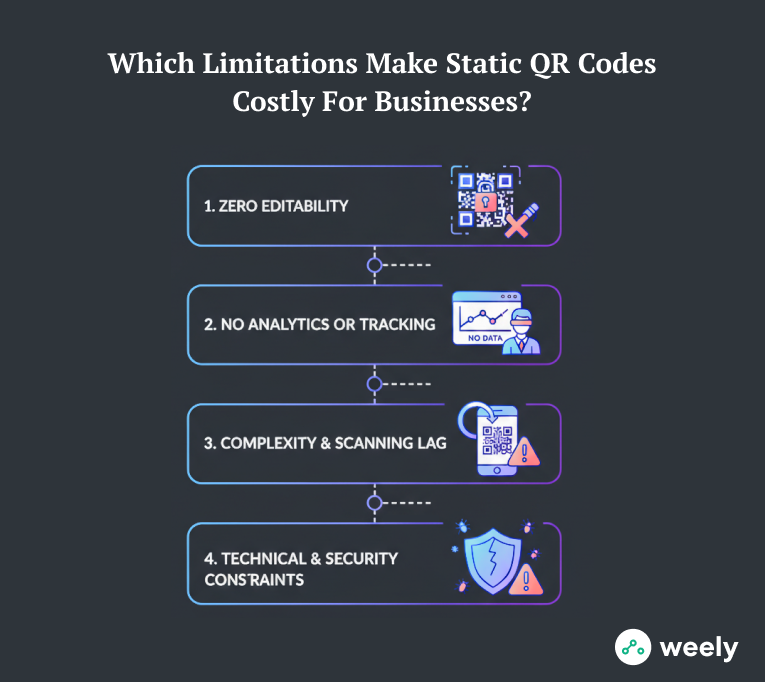
1. Zero Editability
The worst thing about static QR codes is that you can't change them. The data stays the same after you print or share it.
- Reprinting Costs: For example, if you print 10,000 brochures and later find a typo in the URL or your website changes, you will need to make a new code. You also have to print all the materials again.
- Broken Links: If the website you want to go to goes down, the QR code will always show a 404 error. Customers are angry about this. It also hurts people's trust in the brand.
2. No Analytics or Tracking
Static QR codes don't give you any information about how people are using them. So, you can't tell how well a campaign worked. You also can't keep track of:
- How many times do people scan the code
- The place or time of the scans
- The kind of device users have (iOS or Android)
Marketers can't figure out ROI without this information. They can't change strategies right now either. Business may grow less quickly because of this.
3. Complexity and “Scanning Lag”
Static QR codes keep information right in the pattern. More information makes codes thicker. Scanning is harder with denser codes.
- Slower Scanning: Patterns that are very thick might not work well on older smartphone photos. It takes longer to scan because of this. A lot of the time, scans don't work at all once it gets dark.
- Size Requirements: You need to print high-data static codes bigger so that they can still be read. If not, thick codes can mess up design plans that are meant to be clean.
4. Technical & Security Constraints
There are tight limits on static QR codes, and they don't have many safety features:
- Data Limits: A standard QR code can hold up to about 4,296 letters and numbers.
- No Safety Features: They can't protect passwords, check ages, or set up geo-fencing.
- Static Destination: There is no way to show different material based on the situation. For example, you have to change the code by hand to show a breakfast menu in the morning and a dinner menu at night.
Static QR codes may seem easy for businesses that want to grow in the end. But they cost more in terms of protection, tracking, and freedom than you might think.
Which Reasons Make Static QR Codes a Costly Long-Term Liability for Businesses?
Static QR codes might seem like a free and easy fix. But they can be a financial and strategic burden for any business strategy that uses QR codes. The code will always have the data in it. You can't change, track, or improve it after printing because of this.
Businesses waste their marketing budgets over time. They also miss out on useful analytics information. Because of this, the campaign's performance goes down. Here's how static QR codes can hurt your business in the long run:
1. Inability to Update Content (Reprinting Costs)
One of the worst things about static QR codes is that they lock data. You can't change or redirect the content after you print the code.
- Locked Data: The code doesn't change if your website's URL changes, your landing page updates, or a campaign ends. It gets old very quickly.
- Wasteful Reprints: In this case, companies need to make a new code. They also need to print new brochures, flyers, business cards, or QR codes on the packaging of their products.
- Dead Links: When a user tries to access a page that no longer exists, they receive a 404 error. This makes people angry and hurts the brand's reputation.
This is why static QR codes don't work for long-term marketing campaigns.
2. No Analytics or Tracking
Data is essential for effective modern marketing; however, static QR codes do not provide any insight. Without metrics, measuring the effectiveness of a campaign is hard, as well as improving those results.
- Zero Scan Data: There’s no way to track how many times the QR code is scanned.
- No Location Insights: A business will not have access to any data on where or when a QR code is used.
- No Device Data: Businesses do not get any insight into whether the user scanned the QR code using an iPhone or an Android phone.
- Unmeasurable ROI: Without analytics tools, businesses have a hard time calculating their ROI.
With these limitations, static QR codes do not provide businesses with the ability to improve QR code marketing efforts.
3. Increased Risk for Failure
Static QR codes come with many hidden risks, mostly when they are generated through a free QR code generator. Any one of these hidden risks can lead to your campaign failing or developing technical issues over time.
- Unreliable Generation: Many free QR code generation platforms rely on third-party redirects; if the third-party redirect goes away, your QR code will stop working.
- Data Privacy Risks: In addition, several free tools store personal data; using a free tool could expose you to possible compliance violations with regulations like GDPR or CCPA.
- Density and scanning lag: Static codes keep all the information right in the pattern. This can make the code very dense. Dense codes take a long time to scan, especially when they are small or in dim light.
Scanning slowly makes the user experience worse. This means that engagement goes down.
4. Limited functionality and no advanced features
Static QR codes don't have any extra options. Static QR codes are rigid and challenging to adapt to changing business needs.
- No Personalization: Companies can't show different material depending on where you are, what language you speak, or what time of day it is.
- No Security Controls: Static numbers can't employ passwords, end dates, or geo-fencing.
- Not Campaign Flexibility: Businesses can't adjust their ads during Christmas sales. You need to alter the code itself.
Because of these concerns, organizations that are growing shouldn't employ static QR codes for a long time.
The Smarter Alternative: Dynamic QR Codes
Static QR codes could function for information that is only needed once. But dynamic QR codes are the norm for business use. They are flexible, can be tracked, and may grow over time.
Businesses can accomplish these goals with changeable QR codes:
- If you change the target URL, the code that was written will still work.
- Smart tracking tools can help you keep track of scans, locations, and gadgets.
- Please enhance your plan promptly.
- For your business plan, keep a strong and adjustable QR code.
Business QR codes that are set and QR codes that change are very different from each other. You can see results, have more choices, and get a better return on your investment with dynamic solutions.
How to Use QR Codes Effectively in Business
Customers are more likely to interact with QR codes. They can also help marketing work better. But picking the right kind of code is what makes things work. It's also important to put things in the right places in your business materials.
In your QR code for business strategy, here's how to use QR codes well:
1. Use QR Codes on Products and Packaging
Customers can quickly get useful information about products by scanning QR codes. Because of this, the user experience gets better. Trust in the brand also grows.
Businesses can do things like:
- Link to product tutorials or usage guides
- Share warranty registration or support pages
- Offer discounts, loyalty programs, or exclusive content
- Collect customer feedback directly
When put in the right place, QR codes on products make them into interactive marketing tools.
2. Add QR Codes on Marketing Materials
QR codes on ads link campaigns that happen in person and online. So, customers can do something right away.
For instance, you can:
- Add them to flyers, posters, and brochures
- Include them on business cards
- Use them in event banners and trade show booths
- Place them in print advertisements
Also, add a short call to action, like "Scan to Learn More." This makes people more likely to get involved.
3. Choose the Right QR Code Generator
A QR code generator that works well will help you succeed in the long run. It might seem easy to use free tools. But they often don't have advanced features.
Instead, pick a generator that has:
- Making QR codes that change
- Features for tracking and analytics
- Safe handling of data
- Branding options for customization
So, a professional QR code generator gives you flexibility, scalability, and results that you can measure.
4. Check to see if it works with QR code scanners
Before you start a campaign, make sure your code works on a variety of devices and QR code scanner. If scanning doesn't work well, it can lower conversions. It can also make the experience worse for the user.
For the best results:
- Check on both Android and iOS devices
- Check scanning in dim light
- Make sure the size of the code matches the size of the print
- Don't make designs that are too thick, as this can slow down scanning
You can help your business's QR code work as it should by testing it early.
Real-Life Examples: Why Static QR Codes Become Costly
Many businesses believe that QR codes that don't change are cheap and simple to use. On the other hand, true stories present a different perspective. These codes often cause people to lose money, have trouble keeping track of things, and pay more for printing. Many companies become aware of their issues only after producing and distributing the printed materials.
1. Restaurant Menu Update Failure
A restaurant placed static QR codes on table displays that linked to its online menu. However, the QR code continued to display outdated information even after the prices and specials had changed. Customers were confused because of this. The staff had to explain why the prices were different. In the end, the restaurant had to print more materials, which cost more.
2. Real Estate Agency Lost Lead Insights
A real estate company put static QR codes on signs for homes. They were unable to keep track of how many people read the code, which was a shame. Also, when a house was sold, they couldn't send people somewhere else. The company lost useful lead information because of this. So, they missed out on possible buyers and marketing ideas.
3. Retail Brand Faced Reprinting Costs
A store brand put a QR code on the box of a product that led to a limited-time offer. But when the offer was over, the QR code took people to a page that was no longer active. Customers saw mistakes because of this. Customers no longer have the same level of trust in the brand as they once did. The company had to spend extra money and make new packages because of this.
Conclusion
At first glance, static QR codes may look easy and cheap. However, they can't be changed, tracked, or adapted. Because of this, they can give companies a lot of trouble in the long run. For instance, businesses may have to pay for remaking and not have any data. Because of this, marketing doesn't work as well, and useful resources are lost.
So, companies that want to see measurable growth and improve their campaigns should look into a better option. The best thing to do is to switch to a dynamic QR code generator. Companies can keep track of their performance, update their content in real time, and get the most out of their ROI with the right QR code for business.
Frequently Asked Questions
What Are Static QR Codes?
Static QR codes are QR codes that hold information that cannot be changed after they are made. The URL or data that is embedded in a QR code generator stays the same after it is made. Static QR codes are not as useful for long-term business use as dynamic QR codes because they don't let you make changes or track them.
Why static QR codes are considered a costly mistake for businesses?
Businesses can't change or keep track of static QR codes after they print them, which makes them expensive. This implies that businesses are unable to modify links or monitor the effectiveness of scans. They also can't figure out the return on investment (ROI). Because of this, companies often have to pay for reprinting and waste money on marketing.
What are the main problems with static QR codes in marketing campaigns?
One of the biggest problems with using static QR codes in marketing is that they don't give you any analytics or content updates. Also, if someone deletes a page, broken links show up. These limits make it hard for marketers to make the most of a QR code marketing strategy.
How do static QR codes vs dynamic QR codes for business compare?
It's easy to see the differences between static and dynamic QR codes for business. Dynamic codes let you change links and keep track of scans. They also give you better campaign flexibility and analytics tools. Data that doesn't need to be changed should be stored in static codes.
Can you track scans with static QR codes?
You cannot track scans with static QR codes. They don't tell you the scan count, location, device type, or time. Businesses can't measure engagement or figure out their return on investment (ROI) because of this.
Which QR code generator is best for business use?
A business should use a QR code generator that provides dynamic codes as well as robust analytical tools. They need a tool that will keep your data secure, allow you to customize, and improve the performance of your QR code in the long term.
Why do static QR codes fail in long-term marketing strategies?
Static QR codes are not effective in long-term marketing strategies because they are not designed to adapt to changes such as an updated web address or an end to a promotion. Once you have created a code, it will always be the same code, regardless of whether the site or promotion has changed. As a result, when the business changes the code or removes the promotion, they will need to create new codes. This increases costs and reduces efficiency.
Are static QR codes safe for business use?
It's safe to use static QR codes for basic tasks. But they don't have advanced security features like password protection or expiration dates. Some free QR code generators also gather information about their users. Companies may be at risk of data privacy issues if they don't check their privacy practices.