QR codes for magazines link a printed page to a digital destination, such as a video, a product page, or a sign-up form. A reader scans the code with a phone camera and lands on the content in seconds. This makes print easier to measure and much more interactive.
The habit is already common. Statista, using eMarketer data, projected that more than 100 million smartphone users in the United States would scan a QR code by 2025. Readers no longer need an app or a special tool, because the phone camera does the job.
For years, print had one big problem. Publishers could count copies sold, but they could not see what readers did next. Now, QR code in magazines layouts close that gap. They are a simple example of print-to-digital marketing, where a printed page sends people to a screen. Publishers use QR codes on magazines to grow magazine reader engagement, send more visitors to their sites, and show advertisers real results. Smart brands now treat QR codes for magazines as a core part of every print plan.
This guide shows how QR codes for magazines work, how to set them up, how to track results, and which mistakes to avoid.
What Are QR Codes in Magazines and How Do They Work?
A QR code is a square pattern that stores a web address, or other data. When a reader points a phone camera at it, the phone reads the pattern and opens the linked page. No typing is needed. That is why QR codes in print magazines work so well. The reader sees something interesting on the page and reaches the digital version with one quick scan. Most phones scan codes with the camera, and readers can also use an online QR code scanner when needed.
The process has three simple parts. First, the publisher creates a code that points to a page. Second, the code is printed in the magazine. Third, the reader scans it and visits the page. With the right setup, the publisher can also see how many people scanned and what they did next.
Many people call this "interactive print." Others call it interactive print marketing. Whatever the name, the idea is the same. The printed page becomes a doorway, not a dead end. This is also why QR codes in print media have returned in a big way. Today, QR codes on magazines appear on ads, feature stories, and subscription cards alike. When publishers plan QR codes for magazines with a clear goal, each scan becomes a useful signal.
What Can a QR Code in a Magazine Link To?
A code can point to almost any link on the web. The most common choices are these:
- Websites and blog articles
- Videos and behind-the-scenes clips
- Product pages and online stores
- Exclusive digital content
- Discount and coupon pages
- Subscription sign-up pages
- Event pages and ticket forms
- Surveys and reader polls
- Social media profiles
Pick the destination that fits the page. A recipe page should lead to a cooking video. A fashion spread should lead to the shop. A QR code for magazine content works best when it feels like a natural next step.
How Do QR Codes Enhance Reader Engagement With Magazine Content?
QR codes for magazines boost reader engagement by giving readers a quick way to go deeper into a story, watch a video or take action. They add a digital layer on top of the printed page. Readers who want more can scan. Readers who do not can keep reading as usual.
This matters because magazine reader engagement is about more than page views. It is about what readers do after they read. A scan is a clear signal of interest, and it can be counted.
Turn Static Magazine Pages Into Interactive Content
A printed page cannot play a video or show a live price. A QR code can. For example, a travel feature can include a code that opens a short film of the destination. This kind of interactive magazine content keeps readers on the story longer and makes the page feel fresh. A QR code for magazine articles can also link to extra photos, maps, or author interviews.
Give Readers Access to Exclusive Digital Experiences
Readers love feeling special. A code can unlock a bonus interview, a printable guide, or an early look at the next issue. Because only print readers can scan QR codes on magazines, they also give people a reason to value the physical copy.
Connect Print Readers With Websites and Products
Many readers see a product in a magazine and then forget it. A code fixes that. It sends them straight to the product page while the interest is still fresh. This is how QR codes drive traffic from magazines: the reader moves from page to phone in a few seconds, with no search needed.
Use QR Codes to Encourage Immediate Action
Pair the QR code with a simple call to action so readers know exactly what to do. Use clear calls to action like “Scan to watch now” or “Scan to unlock 20% off” so readers instantly understand what they’ll get after scanning. Clear calls to action help QR codes on magazines turn curiosity into clicks, sign-ups and sales.
How Can I Add QR Codes to Magazines to Increase Reader Engagement?
QR code to a magazine is simpler than most people expect. Choose where you want the QR code to lead, generate it, add it to your page design, test the scan, and monitor its performance. Follow these seven steps:
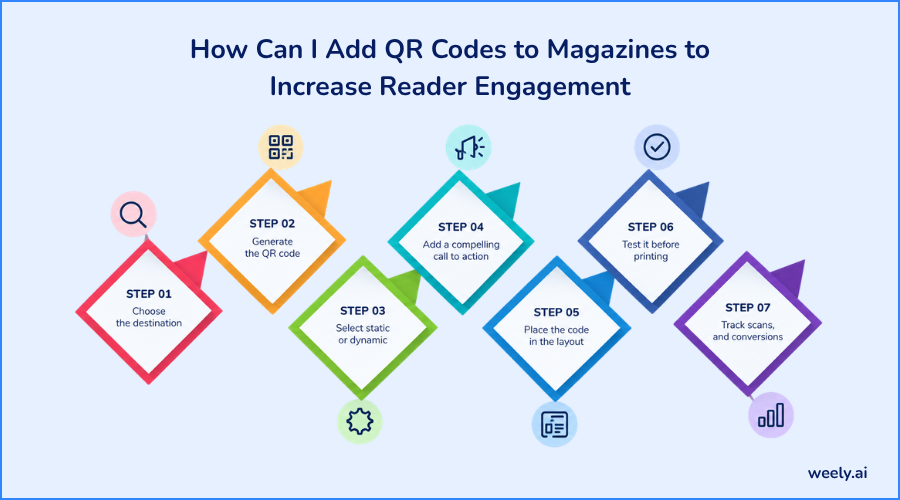
- Choose the destination: Decide what the reader should see after scanning, such as a video, an offer or a story.
- Generate the QR code: Enter your link into a reliable QR code generator and generate a scannable code.
- Select static or dynamic: Pick dynamic if you want to edit the link later or see scan data.
- Add a compelling call to action: Place a short, clear instruction next to the code.
- Place the code in the layout: Put it near the content it relates to, with enough space around it.
- Test it before printing: Scan the proof with several phones.
- Track scans, and conversions: Review the results after the issue is out and learn from them.
Each step matters. Skipping the test or the tracking is where most campaigns go wrong. Following this routine helps you create a QR code for a magazine that works on the first day, and keeps working after the issue ships. Teams that plan QR codes for magazines this way avoid costly print errors.
How to Generate QR Codes for Magazine Print Editions?
To generate a code, you enter your link into a QR code generator for magazines, choose a style, download the file, and send it to your designer. The details below help you get a clean, reliable result for QR codes for print magazines.
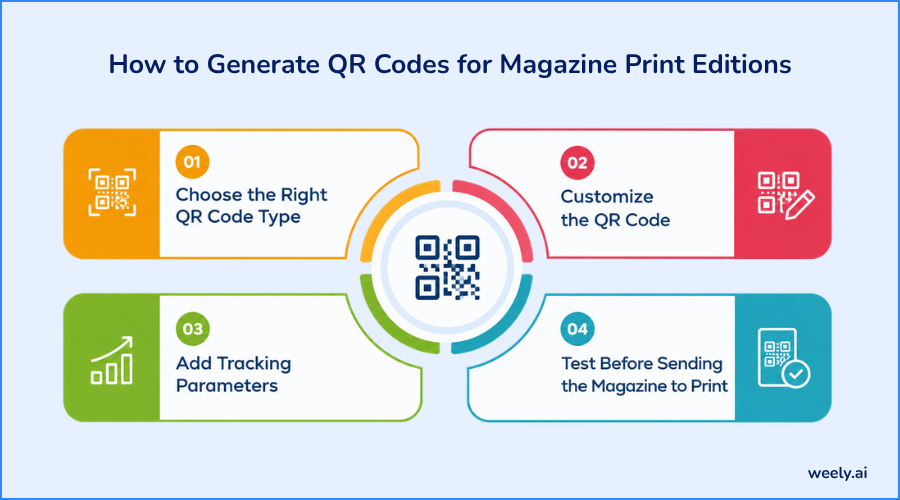
Choose the Right QR Code Type
Start with the link type. A QR code that directs users to a URL is the most widely used option. You can also choose codes for app stores, videos, contact cards or event details. For most QR codes for magazines, a simple URL code pointing to a mobile-friendly page is the safest choice.
Customize the QR Code
You can add brand colors and a small logo. Keep the design simple, though. QR codes are generally easiest to scan when there is strong contrast, such as a dark pattern against a light background. Fancy shapes and low contrast can stop a code from working. Strong QR codes on magazines also need print-ready files, so export a high-quality version.
Add Tracking Parameters
Add UTM tags to your link so your analytics tool knows the visit came from print. You can build them quickly with a UTM generator. A basic example is a link that ends with source "magazine," medium "print," and a campaign name for the issue. This makes it easy to see how to track magazine QR code campaigns inside your normal reports.
Test Before Sending the Magazine to Print
Scan the code from the final proof, not just the screen. Try it on both iPhone and Android, in bright and dim light. Also ask your printer for vector files, such as SVG or EPS, so the code stays sharp at any size. A broken code in print cannot be fixed, so this last check is worth the time.
Static vs. Dynamic QR Codes for Magazines: Which Is Better?
For most marketing work, dynamic QR codes are the better choice. A static code holds the link inside the pattern, so it can never change. A dynamic QR code uses a flexible link, allowing you to update the destination later without creating a new code. You can learn more in this guide to static and dynamic QR codes.
That difference is important in print. A magazine stays on shelves and in homes for weeks or months. Since QR codes on magazines stay in readers' hands that long, the link must stay fixable. A promotion might end, or a page might move. With a static code, the printed link would be stuck. With a dynamic one, you simply update where it points.
Dynamic codes also show data. With a dynamic QR code, you can monitor scan activity, including the number of scans, the time they occurred, and the devices used. Static QR codes, on the other hand, don't provide this type of tracking data. They are still fine for something permanent, like a fixed company website, but they are a weak choice for a campaign. That is why dynamic QR codes for magazines are now the standard for serious publishers and advertisers. Marketers who run QR codes for magazines need that flexibility.
What Are the Best QR Code Generators for Magazine Print Campaigns?
The best dynamic QR code generator is the one that matches your campaign needs. Instead of chasing a ranking, check whether the tool offers the features that matter for QR codes for magazines.
Look for these:
- Dynamic codes with editable destinations
- Scan analytics, and reporting
- Custom colors, logos and print-ready files
- Bulk generation for many ads, or issues
- UTM tracking support
- Campaign folders to keep issues organized
- Integrations with analytics, and marketing tools
- Branded short links
Platforms that offer these tools are often called a QR code marketing platform, or QR code software for publishers. When evaluating different QR code options, consider a few key factors: Can the destination link be updated after the code is printed? Does the solution provide insights such as device type and scan location? Good QR code solutions for publishers answer yes to all three.
A good QR code platform for publishers also supports many campaigns at once. A single issue may carry dozens of codes, from editorial pages to ads. Being able to see every code in one dashboard saves hours. Strong QR code generators for print tools also export clean files, so QR codes on magazines stay sharp on glossy paper.
What Platforms Offer Dynamic QR Code Solutions for Publishers?
Several types of tools offer dynamic QR code solutions, including standalone QR generators, marketing suites, and link-management platforms. Both options offer several key advantages in common. They let you change destinations, collect scan data, run many campaigns, and connect to your other tools.
The data is where the value sits. A good platform shows scan counts over time, the type of device used, and the approximate location of each scan. It also supports UTM parameters, so scans flow into your web analytics. With campaign reports, you can compare one issue to the next or one ad to another. This overview is especially valuable for teams managing multiple QR codes across different magazine campaigns.
Integrations matter too. When your scan data connects with your CRM or email tool, a scan can become a lead. This is the practical side of QR code lead generation, and it is where print starts to feel like any other digital channel.
10 Ways to Use QR Codes in Magazine Advertising
QR codes in advertising give brands a way to turn a one-way print ad into a two-way conversation. Here are ten QR code ideas for magazines and ten QR code ideas for magazine ads that you can adapt right away. Strong QR codes for magazines work for both ads and articles.
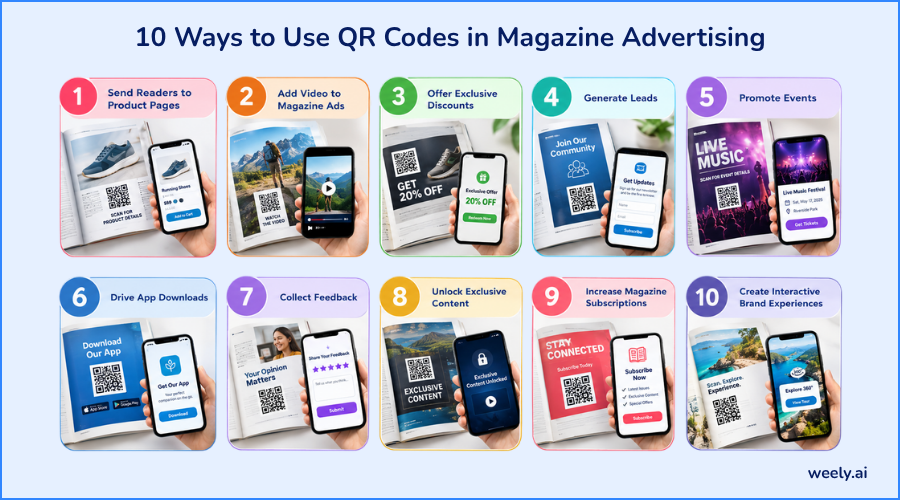
1. Send Readers to Product Pages
Place a code under a product photo that links to the exact item. Add the words "Scan to shop now." This is the simplest form of QR code magazine advertising.
2. Add Video to Magazine Ads
A short video can communicate movement, detail, and context that a single photo simply cannot capture. A beauty brand can share a tutorial, and a car brand can show a drive. Add a clear call to action such as “Scan to watch the complete video.”
3. Offer Exclusive Discounts
Offer print readers a special deal through QR codes on magazines. "Scan to get 20% off" gives people a clear reason to act and you can count every coupon redemption.
4. Generate Leads
Link the code to a short, simple form for a guide or a quote. This makes QR codes for print advertising a real, steady source of QR code lead generation.
5. Promote Events
Let readers register, or buy tickets with one scan using event QR codes. They work well for festivals, launches and local shows. A dynamic link keeps dates and details correct.
6. Drive App Downloads
A clever code sends iPhone users to the App Store, and Android users to Google Play. This saves readers time, so QR codes for magazines are an excellent way to promote apps.
7. Collect Feedback
You can also ask them what they think with a quick poll or survey. You get actionable data, and your readers feel heard. The results can help publishers plan better stories, and offers.
8. Unlock Exclusive Content
Offer bonus photos, extended interviews or downloadable guides through a QR code for magazine content. This rewards loyal readers, and adds real value to each issue, and builds strong, lasting trust.
9. Increase Magazine Subscriptions
A QR code for magazine subscriptions can sit on a card insert or back page and open a sign-up page in seconds. Waiting-room readers can subscribe right on the spot.
10. Create Interactive Brand Experiences
Link to a fun quiz, a game, or a virtual try-on. This is interactive magazine advertising at its very best, because it turns a passive reader into an active participant.
You can also find many QR code examples in magazines by flipping through a recent issue. Look at how fashion, travel, and food titles use QR codes on magazines. Real-world QR code examples for magazine advertising often follow the same pattern: a clear offer, a clean code, and a short instruction.
QR Code for Magazine Ads: How Advertisers Can Get More From Print
A QR code for magazine ads turns a single print impression into a measurable journey. The path looks like this: print ad, QR scan, landing page, engagement, conversion. Each step can be tracked, which means advertisers can finally see where readers drop off and fix it.
Without a code, a print ad is a leap of faith. With QR codes on magazines, it becomes part of a full marketing funnel. The ad creates interest, the scan shows intent, and the landing page closes the deal. Brands that run QR codes for magazines this way learn faster with every issue.
Create a Strong Call-to-Action
Readers will not scan a code they do not understand. Tell them what they get. Good examples include "Scan to watch the full video," "Scan to get 20% off," "Scan to shop now," "Scan to book a demo," and "Scan to read the full story." Keep the words short and active.
Send Readers to a Relevant Mobile Landing Page
Almost every scan happens on a phone, so the landing page must load fast and fit a small screen. Do not send readers to a busy homepage. Send them to the exact page promised by the ad.
Match the Digital Experience With the Printed Ad
The page should look and feel like the ad. Use the same colors, images, and offer. When the reader sees something familiar, trust goes up, and they are more likely to act.
Best Practices for Integrating QR Codes Into Magazine Layouts
The best practices for integrating QR codes on magazines come down to size, contrast, space, and clarity. A code that is easy to see and easy to scan gets more use. A code that is crammed in a corner gets ignored.
Make the code large enough to scan, and keep strong contrast between the dark code and light background. Leave plain white space around it, often called the quiet zone. Place it near the content it relates to, and always add a short call to action. Avoid clutter, because a code surrounded by text and images is harder to read. Make sure the destination works well on a phone, and test the code across devices. Finally, test the actual printed version, because paper, ink, and gloss can change how a code scans. Good layouts make QR codes for magazines far easier to scan.
Where Should a QR Code Be Placed in a Magazine?
Place the code next to the story, photo, or offer it supports. Outer edges and lower corners of a page are easy for readers to reach. Avoid the fold in the middle, because the curve can bend the code and make scanning harder. Also avoid glossy spots that reflect light.
How Large Should a QR Code Be in a Magazine?
A common rule of thumb is a minimum of about 2 x 2 cm or roughly 0.8 inches, for a basic code. Larger sizes are safer for codes with long links or detailed designs. Read this guide on choosing the right QR code size for more detail. Since paper type and print method affect results, always test a proof before the final run.
How Do QR Codes in Magazines Improve Marketing ROI?
QR codes for magazines make print campaigns measurable, which helps teams make smarter choices about magazine advertising ROI. They do not guarantee better returns on their. Results depend on your offer, your audience, your placement and your landing page.
What the code gives you is visibility. You can track scans, website visits, leads, purchases, coupon redemptions, subscriptions, and conversions. Before, a brand might spend money on a full-page ad and only guess at the result. Now it can see how many readers scanned and what they did.
From Magazine Impression to Digital Conversion
Think of it as a simple path: impression, scan, visit, engagement, conversion. If many people scan but few buy, the landing page or offer may need work. If few people scan at all, the call to action or placement may be the problem. This kind of insight is what makes QR code conversion tracking so useful. It shows you exactly which part of the chain to fix.
Strong QR code marketing for magazines pairs a clear call to action with a good offer, a smart position on the page, the right audience, a fast mobile page, and proper tracking. Remove any one of these and the results usually suffer.
What Services Track QR Code Scan Data From Print Media?
Dynamic QR platforms, link-management tools, and web analytics software can all track scans from print. This is the basis of QR code analytics, and it is how publishers can track QR code scans from each issue. The best setups combine a dynamic code with UTM tags so data appears both in the QR tool and in your web reports. That way, QR codes on magazines become as easy to measure as any online ad.
What QR Code Data Can Publishers Track?
Most platforms report scan volume, the date and time of each scan, the device type, the approximate location, the campaign name, the traffic source, and the conversions that follow. With this data, QR code analytics for print campaigns can show which ads, pages and issues perform best. It can also show when readers scan, which helps with planning future content.
How UTM Parameters Help Track Magazine QR Codes
UTM parameters are small tags added to the end of a link. They tell your analytics tool where a visit came from. For example, tagging a link with source "magazine," medium "print," and campaign "spring-issue" lets you separate print traffic from social or email traffic. Good QR code campaign tracking depends on this tagging. It also makes QR code scan tracking much cleaner, because every code gets its own label.
Where Can I Find Examples of Successful QR Code Use in Magazine Ads?
Practical examples appear across many magazine types. The ones below are example scenarios, not named case studies, but they show how QR code campaigns for print magazines usually work.
A fashion magazine can place a code beside a styled outfit that opens the full product collection. A travel magazine can link a destination photo to a detailed guide with maps and hotel tips. A food magazine can add a code to a recipe that opens a cooking video. A technology magazine can point a gadget review to a product demonstration. A car magazine could place a QR code in an advertisement that takes readers directly to a test-drive registration form. A business magazine can link a feature on leadership to a webinar registration. A lifestyle magazine can pair a code with a discount campaign for a partner brand.
In each case, the code sits next to something readers already care about, and the destination gives them the next step. That pairing is what makes trackable QR codes for magazines so effective for advertisers and editors alike. It is also why QR codes for magazines work best when they match the page around them.
QR Codes vs. Traditional Magazine Advertising
A traditional print ad builds brand awareness well, but it has limits. It cannot show how many people took action, and it cannot change after printing. A QR-enabled ad keeps all the strengths of print, and adds digital features. It drives direct website traffic, allows scan tracking, supports lead generation, and makes conversion measurement far easier. With dynamic codes, the digital content can even be updated after the magazine is printed. In short, QR codes for magazines keep print's trust and add digital proof.
Common QR Code Mistakes Magazine Publishers Should Avoid
Even a good idea can fail if the code is poorly set up. Watch out for these common problems. The same rules apply to QR codes on flyers and other print pieces.
The first is size and design. A code that is too small or has poor contrast will not scan. Next is the message. A code with no call to action leaves readers guessing, and a destination that does not match the ad feels like a bait-and-switch. Technical errors are the most painful. A broken URL, a page that does not work on mobile or an outdated campaign link can ruin a whole print run. Tracking mistakes are common as well, such as skipping analytics or forgetting UTM parameters, which leaves you blind to results. Finally, do not skip testing before printing, and do not fill a page with too many codes. One clear code per page or ad is usually enough for QR codes on magazines.
How Publishers Can Build a QR Code Strategy for Every Magazine Issue
A good plan treats every code as part of a chain: content, QR code, call to action, landing page, tracking, and optimization. Each link in the chain must work for the whole thing to succeed.
Start with the content. Decide which pages deserve a code, such as editorial features, advertisements, sponsored content, subscription pages, events, product recommendations and premium content. For each one, choose a clear goal and a matching call to action. Then build a mobile page that delivers on the promise, add tracking, and review results after the issue is out.
Over time, you will learn which pages earn the most scans. A strong QR code for magazine publishers plan uses that learning to improve every issue. Many QR codes for magazine publishers also work well in a series, with the same style across issues so readers learn to recognize and trust them. A steady plan for QR codes for magazines also makes each issue easier to compare with the last.
The Future of QR Codes in Magazines
The next stage of print is more interactive and more personal. Expect richer interactive print, dynamic content that changes by date, or reader, and personalized experiences based on location, or interests. AI-powered experiences, such as chat-based guides, may soon sit behind a scan. Shoppable magazines, where every product has a code, are also growing. On the data side, campaign attribution will keep improving, giving publishers a clearer view of the full print-to-digital journey. The future of QR codes for magazines looks smarter, more personal and easier to measure, and QR codes on magazines will likely become a normal part of every issue.
Turn Your Magazine Into an Interactive Experience
QR codes do not replace great magazine content. They extend it. A strong story still grabs attention, and a good ad still builds the brand. The QR code gives readers an easy way to continue exploring the content or take the next step.
Publishers and advertisers can use QR codes for magazines to connect readers with digital content, drive traffic, generate leads, and measure engagement. Start small. Add one well-placed code to your next issue, track it, learn from the results, and improve. When you are ready to set up your first campaign, create an Weely AI account and build your first code. Over a few issues, QR codes on magazines will build a print-to-digital habit that readers enjoy and advertisers value.